Vouch Rank: a self-hosted Semrush alternative
Real keyword data, weekly rank tracking, and AI-assistant visibility, for roughly 1% to 3% of the subscription price.
Three things worth knowing.
An AI agent team built a working Semrush alternative in four days. The owner never wrote a line of code.
It runs unattended, on a schedule, for roughly 1% to 3% of a Semrush subscription.
The most valuable data source turned out to be free. Google Search Console caught what both paid vendors missed.
Semrush-level reporting, without the Semrush bill.
A boutique PR and communications consultant needed Semrush-level SEO reporting for a small group of clients, but without the scale or cost of Semrush. Semrush runs $140 to $500 per month, and most of that price pays for features this use case simply did not require.
The goal was a self-hosted light version of Semrush. Real keyword research data, automated weekly rank tracking, AI-assistant visibility tracking, and printable client reports.
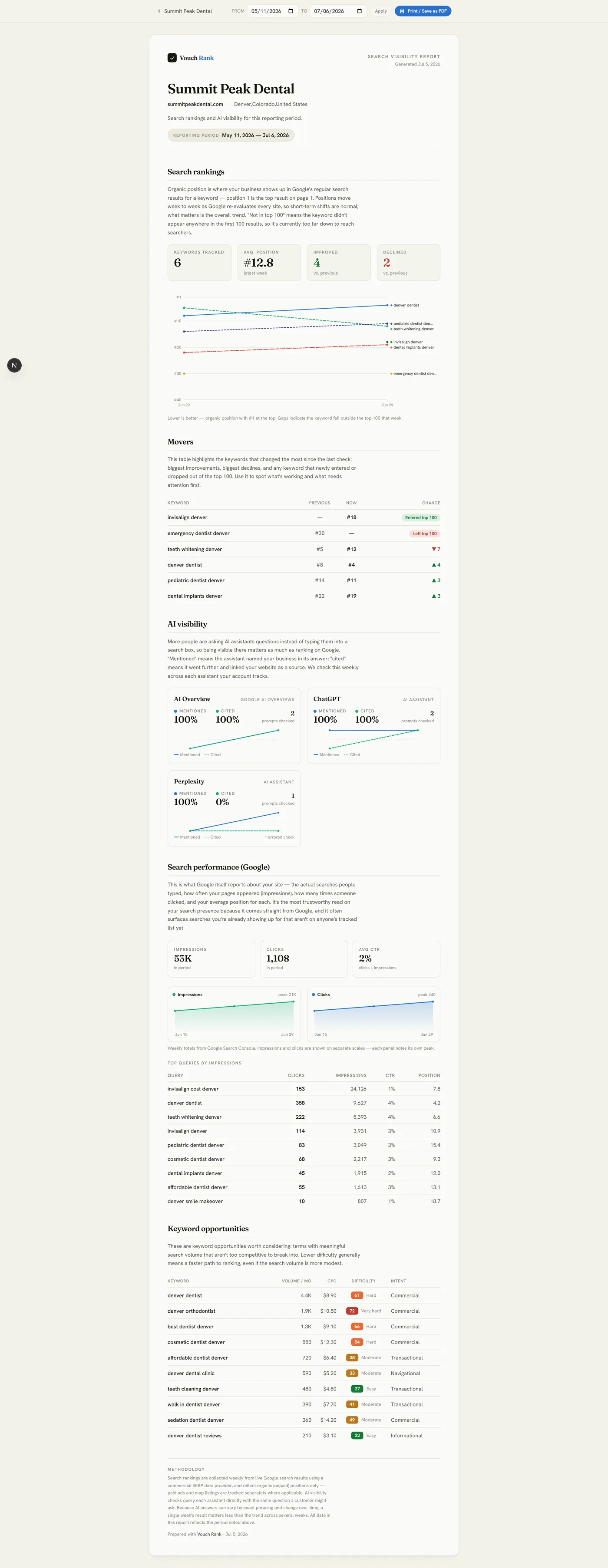
A working product in four days.
One orchestrator model directed specialist coder and researcher subagents. The owner made only product decisions and handled account signups.
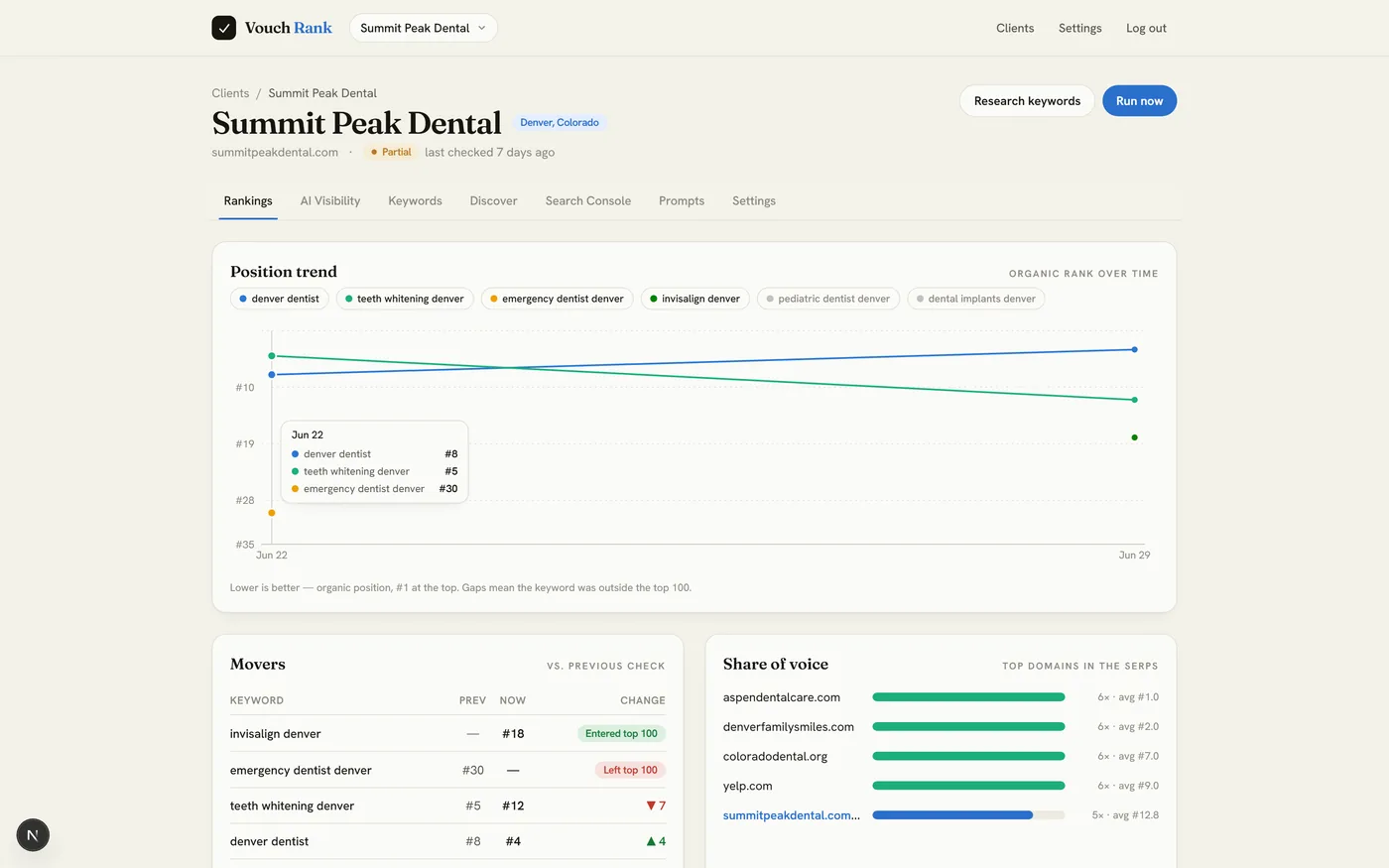
Keyword research
Live search-volume and difficulty data from DataForSEO.
Weekly rank tracking
Geo-targeted to each client’s city, with trend charts and a weekly movers list.
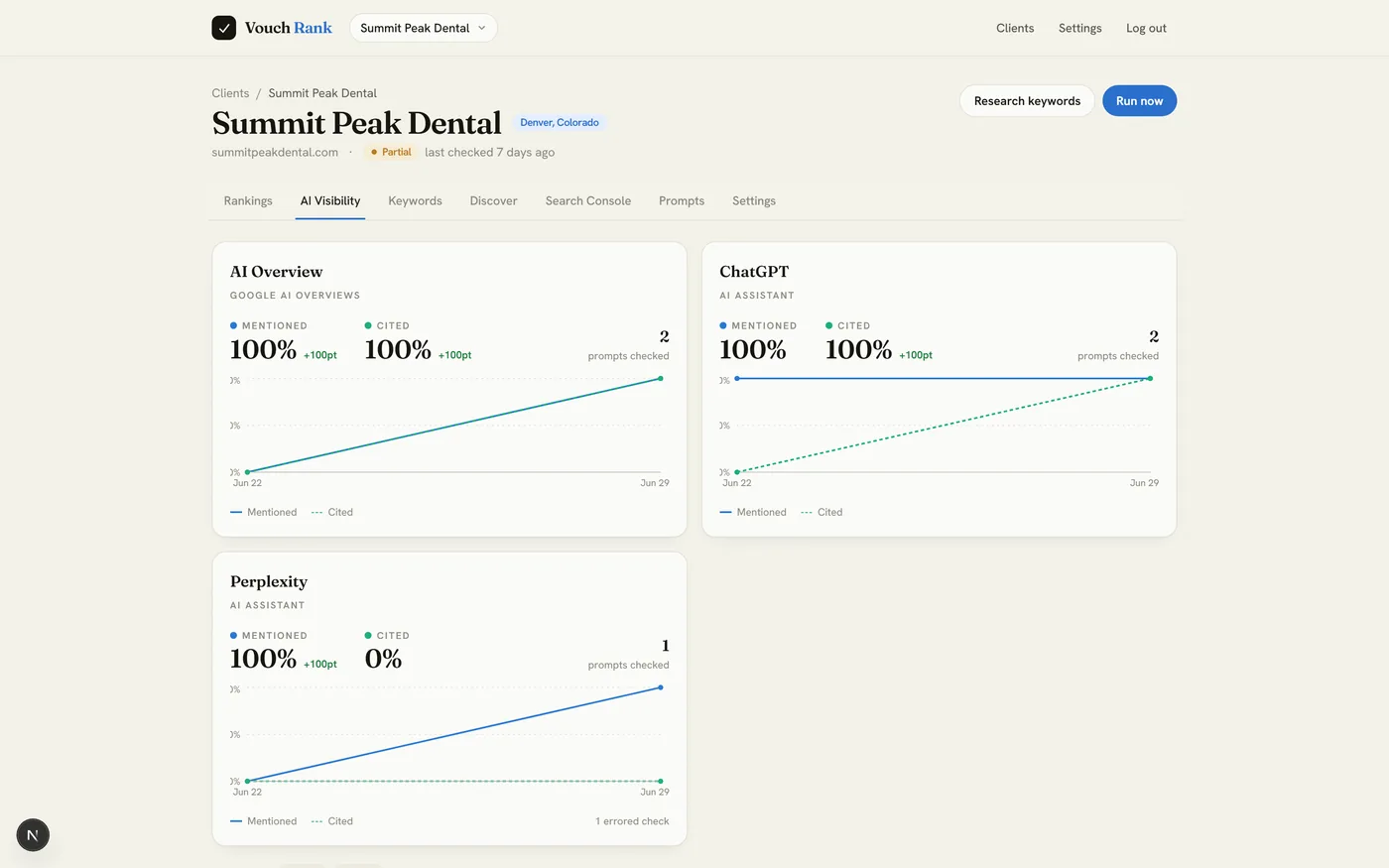
AI visibility, five surfaces
Checks whether each assistant mentions the client and cites their site. On or off per client.
Monthly keyword discovery
Every keyword the domain ranks for in Google’s top 100, with drill-down history and badges.
Google Search Console
Google’s own queries, clicks, and impressions, plus an Opportunities panel with one-click tracking.
Forgiving location input
Type “OKC” or “oklahoma city.” The backend resolves the vendor’s canonical geo code.
Printable client report
Plain language for business owners, with custom typography and print-perfect SVG charts.
Hardened and capped
Auth, rate-limited login, health checks, and cost caps on every external API call.
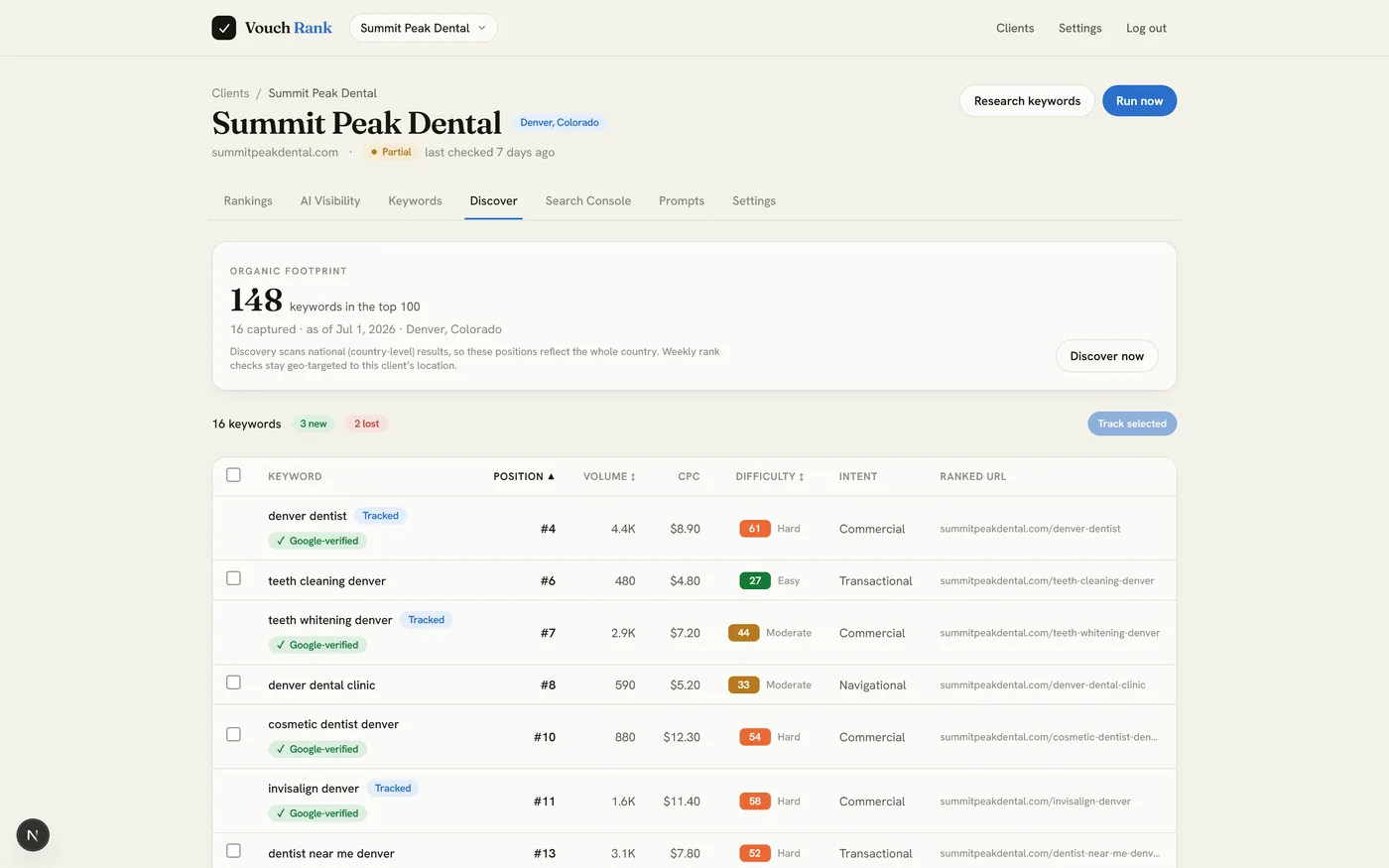
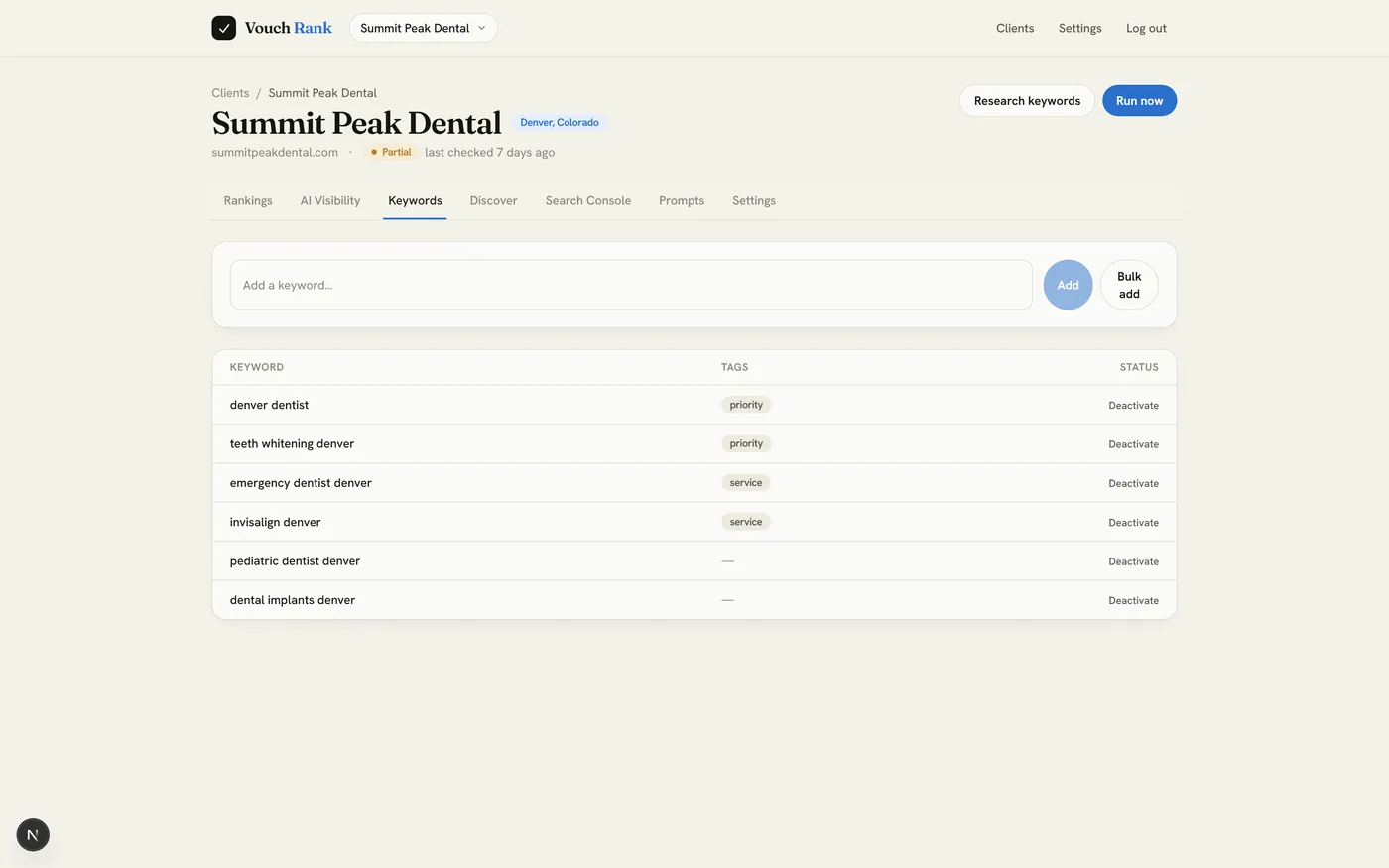
The experiment that changed the product.
The team compared its own discovery pull against a Semrush export for the same domain. Then it checked both against Google Search Console’s ground truth. The result was clarifying.
Ground truth. The tie-breaker both counts were checked against.
impressions on one question query, sitting on page 1. The domain’s single biggest real search asset.
That finding changed the direction of the product. Google Search Console integration became the priority, ahead of chasing larger vendor keyword counts. Real traffic mattered more than a bigger database.
“Does ChatGPT know about us?”
Small-business clients are already asking. Vouch Rank answers with weekly, longitudinal data across five assistants, for only a few cents a week.
Find it. Refute it. Fix it.
Every feature PR went through a multi-agent adversarial review. Independent reviewer agents searched for issues from different angles. Then separate verifier agents tried to refute each finding before it was accepted.
A finding only counts if it survives an agent whose whole job is to prove it wrong.
Feature PR
Coder agents write the change. 389 automated tests run against it.
Verifier agents
A separate agent attacks every finding and tries to prove it wrong.
Discarded
False alarms never reach the owner.
Fixed before merge
Confirmed issues get fixed while the PR is still open.
A few memorable problems.
The invisible newline
A Railway environment variable contained an invisible newline character in its name. It looked identical in the dashboard, but it silently broke credential loading. The issue was found only by diffing the CLI output character by character.
Seven failed deploys
An npm 10 runtime silently rejected an npm 11 lockfile. That caused seven failed deploys in a row, and even Railway’s own AI misdiagnosed it twice. The real fix was pinning Node 24.
The quiet IP block
The data vendor’s anti-abuse system quietly blocked the cloud server’s IP address. It lifted once an email verification step was completed.
Honest about what it is not yet.
Single-user
No client logins or multi-tenant access.
Resolution mismatch
Discovery data is national. Weekly rank checks are city-level. The two do not yet match.
Smaller keyword database
Roughly four times smaller than Semrush’s. Search Console ground truth helps offset the gap.
No backlinks, audits, or citations
No backlink analysis, no full site audit, no local citation tracking.
Noisy single weeks
AI checks run one prompt per phrasing. The real value is in trends across several weeks.
Print CSS, not a PDF system
The report still uses browser print CSS rather than a dedicated PDF design system.
The next steps are already clear.
The highlights feed pairs win and risk events with celebration animations, so the dashboard tells clients what happened instead of just storing it.